
How to Improve VO₂max: Why Airbikes Make Sense for Age-Group Athletes
 Karen Parnell
January 06, 2026
Karen Parnell
January 06, 2026
How to Improve VO₂max: Why Airbikes Make Sense for Age-Group Athletes
If you’re an age-group or recreational athlete, chances are you’re balancing training with work, family, and real-life commitments. You want to get fitter — but you don’t necessarily have more hours to train.
That’s where VO₂max training and the often-misunderstood airbike (fan bike / Assault-style bike) can make a real difference. Backed by solid research, airbikes offer a time-efficient, low-impact way to improve aerobic fitness — making them a very sensible addition to a home gym.
If you prefer to listen to Blogs you can listen to it here:
Get your FREE 31 Structured Cycling Sessions and Training Plan
What is VO₂max?
VO₂maxis the maximum amount of oxygen your body can use during very hard exercise. In simple terms, it represents the size of your aerobic engine.
For non-elite athletes, a higher VO₂max usually means:
- Hard efforts feel more manageable
- Race pace feels smoother and more controlled
- Recovery between hills, surges, and sessions improves
You don’t need to be chasing podiums for VO₂max to matter. Raising your aerobic ceiling makes all sub-maximal efforts — endurance, tempo, even recovery days — feel easier.
VO₂max norms: what’s considered good by age and sex (ml·kg⁻¹·min⁻¹)
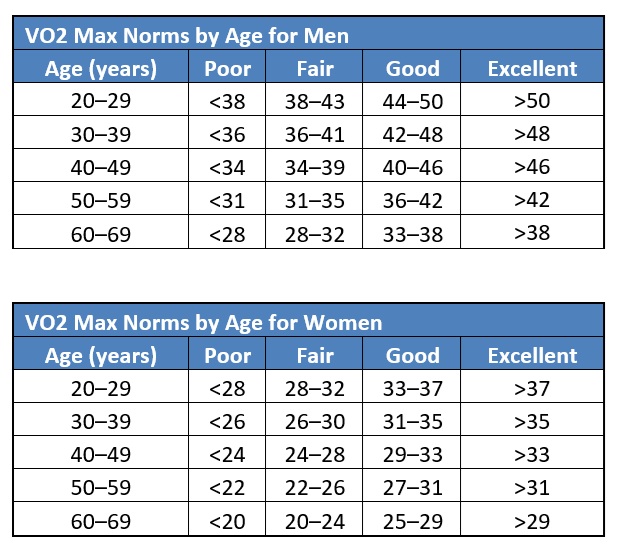
A “good” VO₂max doesn’t mean elite-level fitness. It reflects aerobic capacity above the general population and is achievable for many age-group athletes with consistent training.
Improving VO₂max isn’t about chasing a specific number — it’s about raising your ceiling so everyday training and race efforts feel more comfortable.
How VO₂max Actually Improves
VO₂max depends on how well your heart, lungs, blood, and muscles work together to deliver and use oxygen. To improve it, that system needs to be challenged close to its upper limits.
This is where high-intensity interval training (HIIT) becomes important.
What the research consistently shows
- Interval training reliably improves VO₂max across recreational, trained, and elite populations
- Meta-analyses show HIIT is at least as effective — and often more time-efficient — than moderate continuous training
- Classic protocols such as the Norwegian 4 × 4-minute intervals improve VO₂max and cardiac stroke volume in as little as 6–8 weeks
For busy athletes, this is good news: you don’t need endless training volume — you need well-placed intensity.
Get your FREE 23-Page Athletes Guide to Strength and Conditioning
What the Research says about How to Raise VO₂max
When it comes to improving VO₂max, the research is remarkably consistent.
Multiple meta-analyses and systematic reviews show that high-intensity interval training (HIIT) or interval training performed at high intensities leads to larger improvements in VO₂max than low-intensity steady-state training alone for many athletes (Bacon et al., 2013; Milanović et al., 2015).
While low-intensity endurance training remains important for building aerobic base and overall durability, studies repeatedly demonstrate that it typically produces small to modest increases in VO₂max, particularly once an athlete is already reasonably trained. In contrast, HIIT produces larger and more time-efficient gains in aerobic capacity.
Research also shows that specific HIIT formats are especially effective — particularly those that push athletes into or very close to their VO₂max for repeated bouts. Well-supported examples include:
- Intervals of 3–5 minutes at ~90–100% of VO₂max with adequate recovery
- Structured protocols such as the Norwegian 4×4-minute interval session
These formats consistently elevate oxygen uptake to near-maximal levels and keep it there long enough to stimulate meaningful cardiovascular and muscular adaptations (Helgerud et al., 2007; Wen et al., 2019).
For time-limited age-group athletes, this is a key takeaway: you don’t need endless hours of training to raise VO₂max — you need short periods of very well-targeted intensity.
Why Airbikes are Especially Effective for VO₂max Work
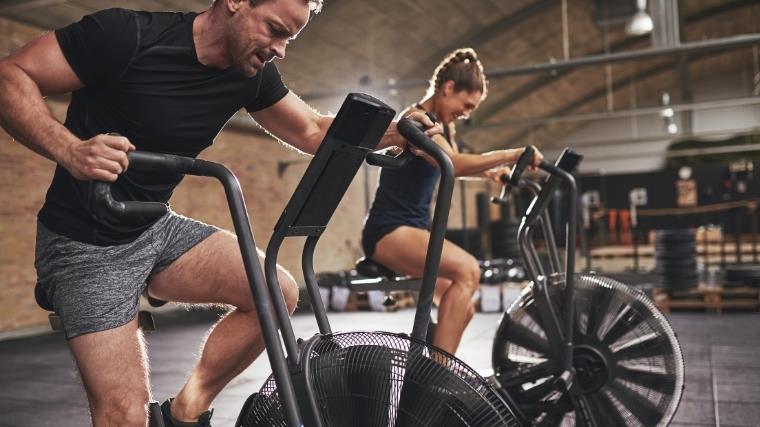
Airbikes sometimes get written off as “CrossFit punishment,” but from a physiological and coaching perspective, they make a lot of sense.
1. Whole-body work drives oxygen demand quickly
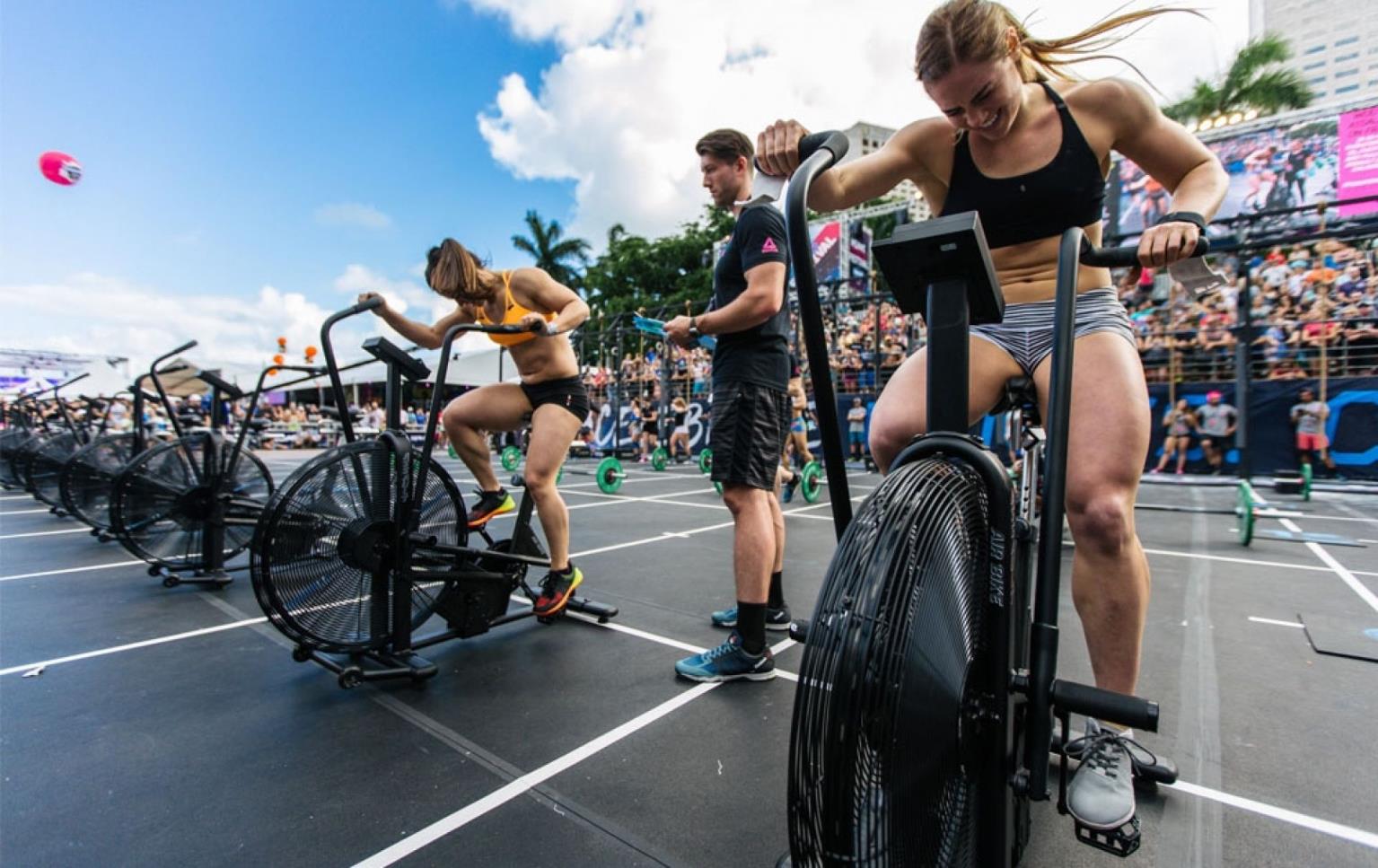
Airbikes use arms and legs together, creating a higher metabolic and oxygen demand than leg-only cycling. Several laboratory studies comparing airbikes with traditional cycle ergometers have shown:
- Comparable or higher VO₂max values
- Higher heart rate and blood lactate responses
- Clear evidence that airbikes can elicit true maximal effort
In practical terms, airbikes get you into VO₂max territory faster.
Get your FREE 31 Structured Cycling Sessions and Training Plan
2. Self-regulating resistance (ideal for intervals)
There are no gears on an airbike. Push harder and resistance increases automatically; ease off and it drops immediately.
That makes them:
- Easy to pace by feel (RPE)
- Forgiving when fatigue builds
- Ideal for HIIT without obsessing over speed or wattage
For recreational athletes, this removes a lot of stress while keeping training effective.
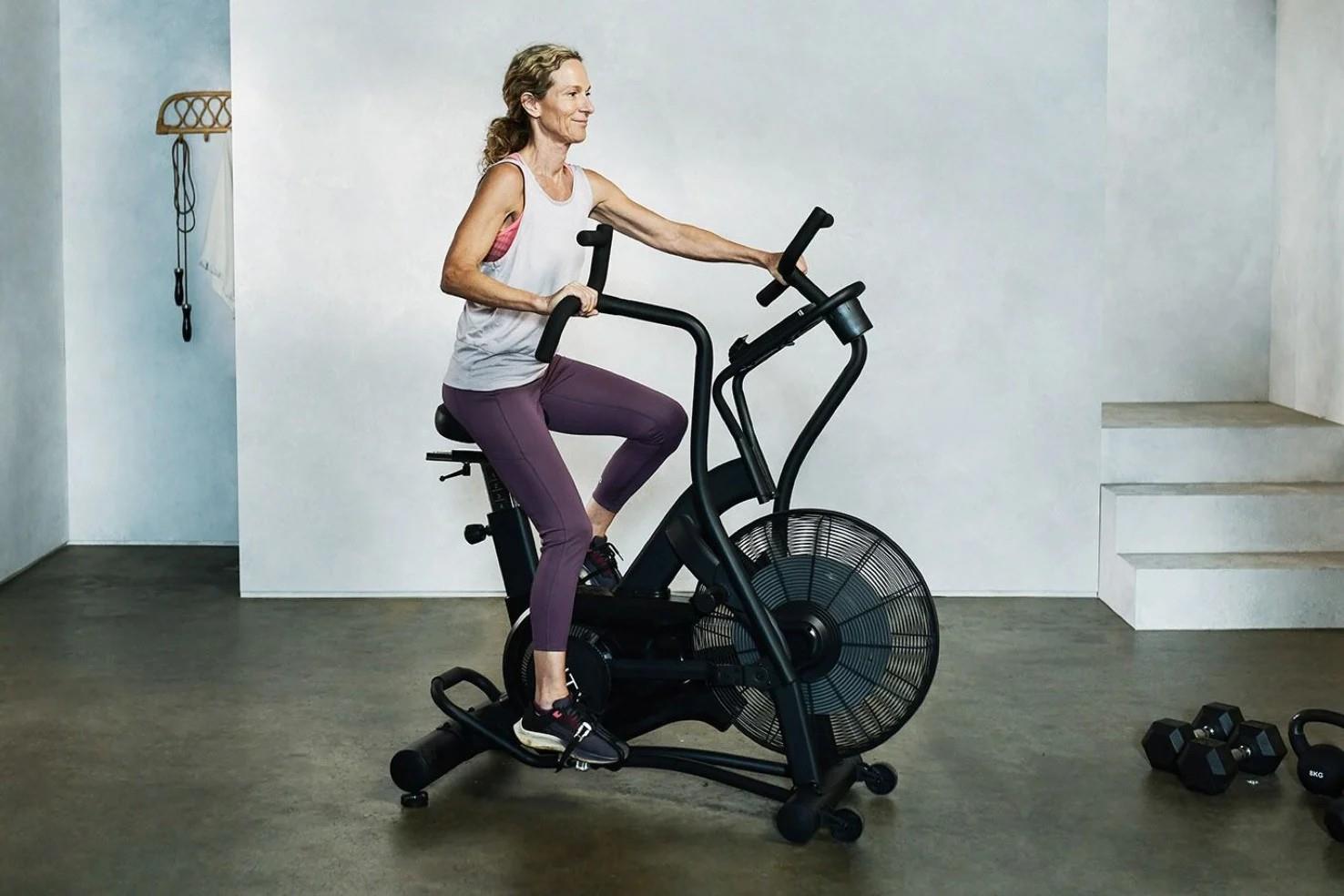
3. High intensity, low impact
Airbikes deliver:
- Very high cardiovascular stress
- Minimal joint impact
This makes them especially useful if:
- You already do a lot of running
- You’re managing niggles or returning from injury
- You want intensity without additional pounding
Many athletes successfully use airbikes to maintain or improve VO₂max during injury-management phases.
Get your FREE 23-Page Athletes Guide to Strength and Conditioning
4. Supported by growing research
While treadmills and laboratory cycle ergometers dominate much of the older VO₂max research, newer studies show that airbikes (fan bikes / Assault-style bikes):
- Produce reliable VO₂max and HRmax values (Canário-Lemos et al.; Lipscomb et al., 2024)
- Elicit true maximal physiological responses, comparable to traditional ergometers (Pearson et al., 2023)
- Are valid for repeated high-intensity interval work, making them suitable for both testing and training (Pearson et al., 2023)
The evidence base is smaller than for traditional ergometers — but it is growing and encouraging.
What do Experts Say about Airbikes?
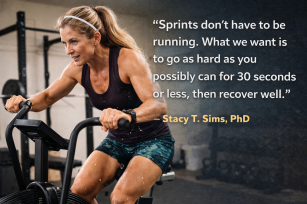
Exercise physiologist Dr. Stacy Sims, who frequently discusses HIIT and sprint-based interval training (SIT), highlights that maximal efforts don’t need to involve running:
“Sprints don’t have to be running. What we want is to go as hard as you possibly can for 30 seconds or less, then recover well.”
— Stacy T. Sims, PhD
For SIT training she suggests it is “30 seconds or less as hard as you can go, with a recovery to 2 to 4 minutes”. For this type of training, she goes on to say, “a good option is an assault bike or air bike”.
This philosophy aligns perfectly with airbike training: short, intense, full-body efforts with adequate recovery.
Dr. Stacy Sims on YouTube: What’s the safest way to start sprint training in your 40s?
Dr. Jocelyn Wittstein, MD, Sports Medicine Specialist says “My absolute favourite option for intervals is the airbike. You can incorporate your arms and legs and get your heart rate up quickly. Interval training is good for your heart (can improve VO2 max) and your brain!”
Dr. Wettstein specialises in women’s health and bone density, highlights the broader benefits of high-intensity cardiovascular training — while also emphasising its limitations.
“Neuroprotective BDNF (Brain-Derived Neurotrophic Factor) is released with cardiovascular exercises, especially with high intensity intervals. We often hear how important strength training is (and yes, it is for metabolic health and bone health and even brain health), but cardio matters.
150 min a week of moderate intensity exercise reduces dementia risk and 1 or 2 Norwegian 4x4 sessions as part of your cardio can help improve VO2 max. The only downside of the bike is that it does not improve or protect bone density- don’t forget your strength training and jumping or impact alternatives.”
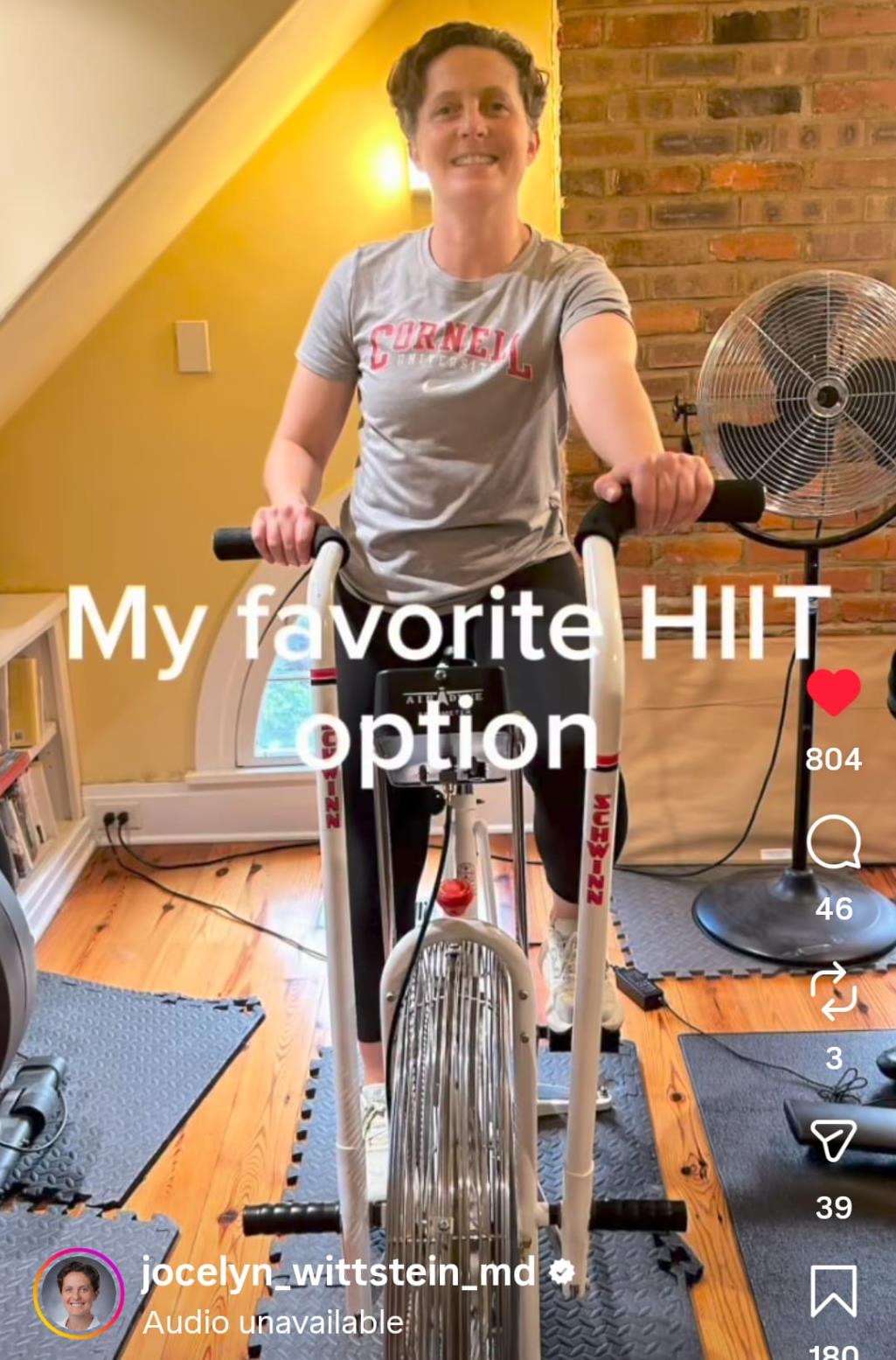
Dr. Jocelyn Wittstien, MD on Instagram: Sprint interval training on an Airbike
Exercise physiologist Martin J. Gibala, PhD, whose research underpins much of modern high-intensity interval training, explains that when scientists talk about “fitness,” they are often referring specifically to aerobic capacity:
“Fitness means different things to different people. To exercise scientists, it means cardiorespiratory fitness — a parameter that can be measured in the laboratory by way of a test called maximal oxygen uptake, or VO₂max.
It is also called aerobic fitness, and it refers to the capacity of your body to transport and utilise oxygen. Scientists have found that it’s one of the best predictors of overall health.”
Crucially for busy, real-world athletes, Gibala’s work also shows that improving this form of fitness doesn’t require long hours of training. Instead, intensity plays a key role:
“Intensity is more important than duration. Brief, hard efforts can deliver the same benefits as much longer sessions of moderate exercise.”
Together, these ideas help explain why short, high-intensity sessions — like airbike intervals — are such an effective way to improve VO₂max. By allowing athletes to reach very high intensities quickly and safely, airbikes make it easier to apply the principles that research consistently supports.
Simple, Evidence-Based Airbike Workouts
You don’t need lab testing or complex metrics. Use Rate or Perceived Exertion (RPE) effort levels and breathing as your guide.
Workout 1: The classic Norwegian 4 × 4
Total time: ~40 minutes
- Warm-up: 10–15 min easy
- 4 × 4 min hard (RPE 8–9/10)
- 3 min easy spin between efforts
- Cool down: 5–10 min
This protocol has strong research support for improving VO₂max.
Workout 2: 30/30s (busy-day favourite)
Total time: ~25–30 minutes
- Warm-up: 10 min
- 10–15 ×
- 30 sec very hard (RPE9-10/10)
- 1 – 2 mins easy
- Cool down
Short, sharp, and very effective.
Workout 3: 5 × 2 minutes (great entry point)
- Warm-up: 10–15 min
- 5 × 2 min hard (RPE8-9/10)
- 2 min easy between
Hard but manageable — ideal if you’re new to HIIT.
Get your FREE 23-Page Athletes Guide to Strength and Conditioning
How Often is Do You Need to do VO2 Max Training?
For most age-group athletes:
- One VO₂max-focused session per week is enough to see improvements
- Two per week is plenty if recovery is good
More than that rarely adds benefit and can interfere with consistency.
Why an Airbike Makes Sense in a Home Gym
From a coaching perspective, airbikes tick a lot of boxes:
- Time-efficient
✔Durable and low maintenance
✔No subscriptions or software
✔Useful for HIIT, aerobic work, and recovery
✔ Low impact with high cardiovascular return
If you train early mornings, late evenings, or in short windows, few tools deliver more fitness per minute.
Most commercial gyms now include assault or air bikes in their standard equipment list so if you do your strength sessions at the gym you can add in a cheeky HIIT or SIT session to your normal session.
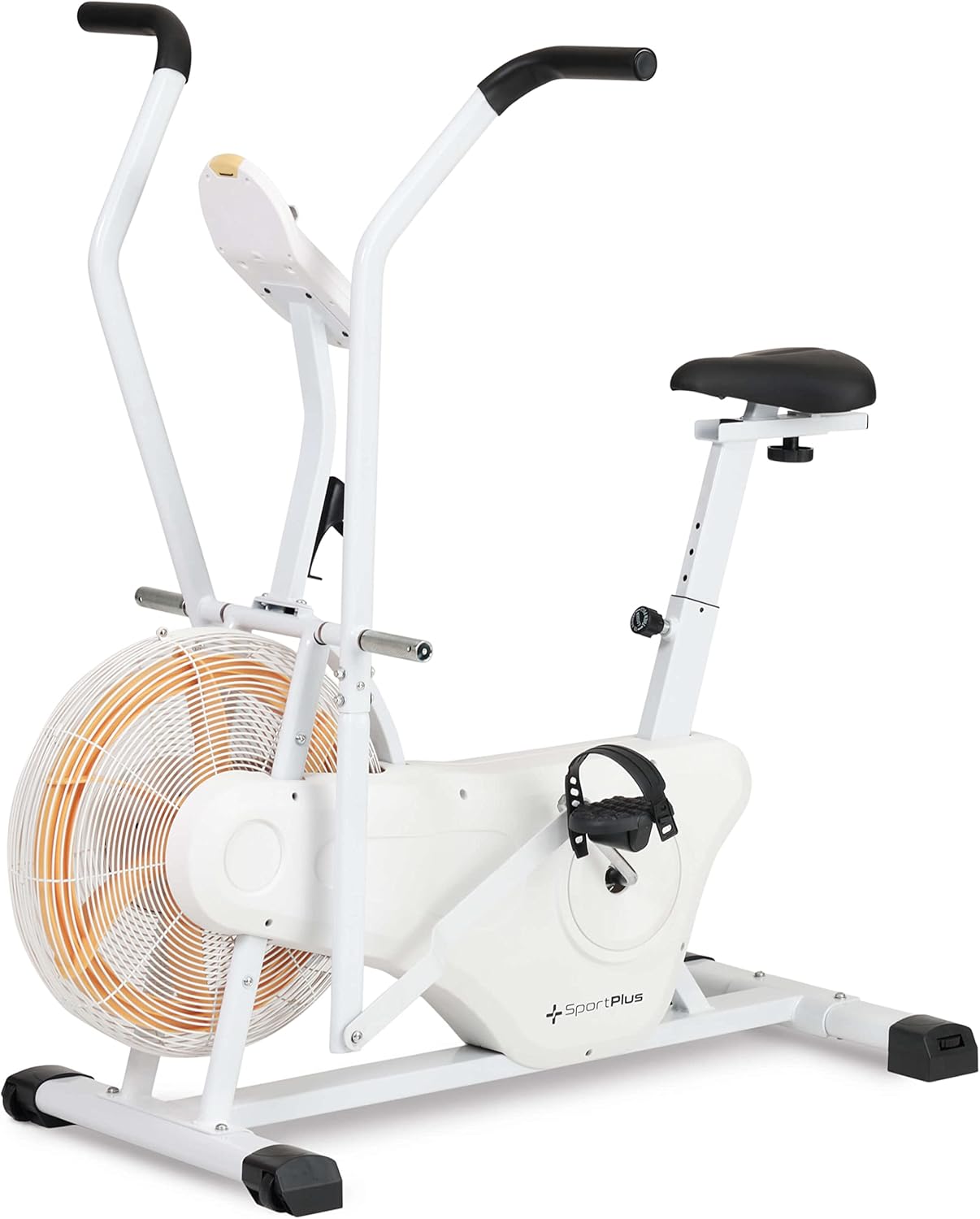
I recently added an Airbike to my home gym and found one that is surprisingly good value for money on Amazon. The one I have is the SportPlus Fanbike SP-FB-2100-W-iE with Bluetooth for around £150/€169.
It has Bluetooth for connection to Apps but the one they recommend is Kinomap. It can display hear rate on the display but requires a 5.3khz heart rate monitor which used to be standard in gym equipment. I have Technogym one form my gym days in the UK, but you can also get them at Decathlon for €12 / £10. It’s not ideal but for the value it gives and the price it cost I found it worth it.
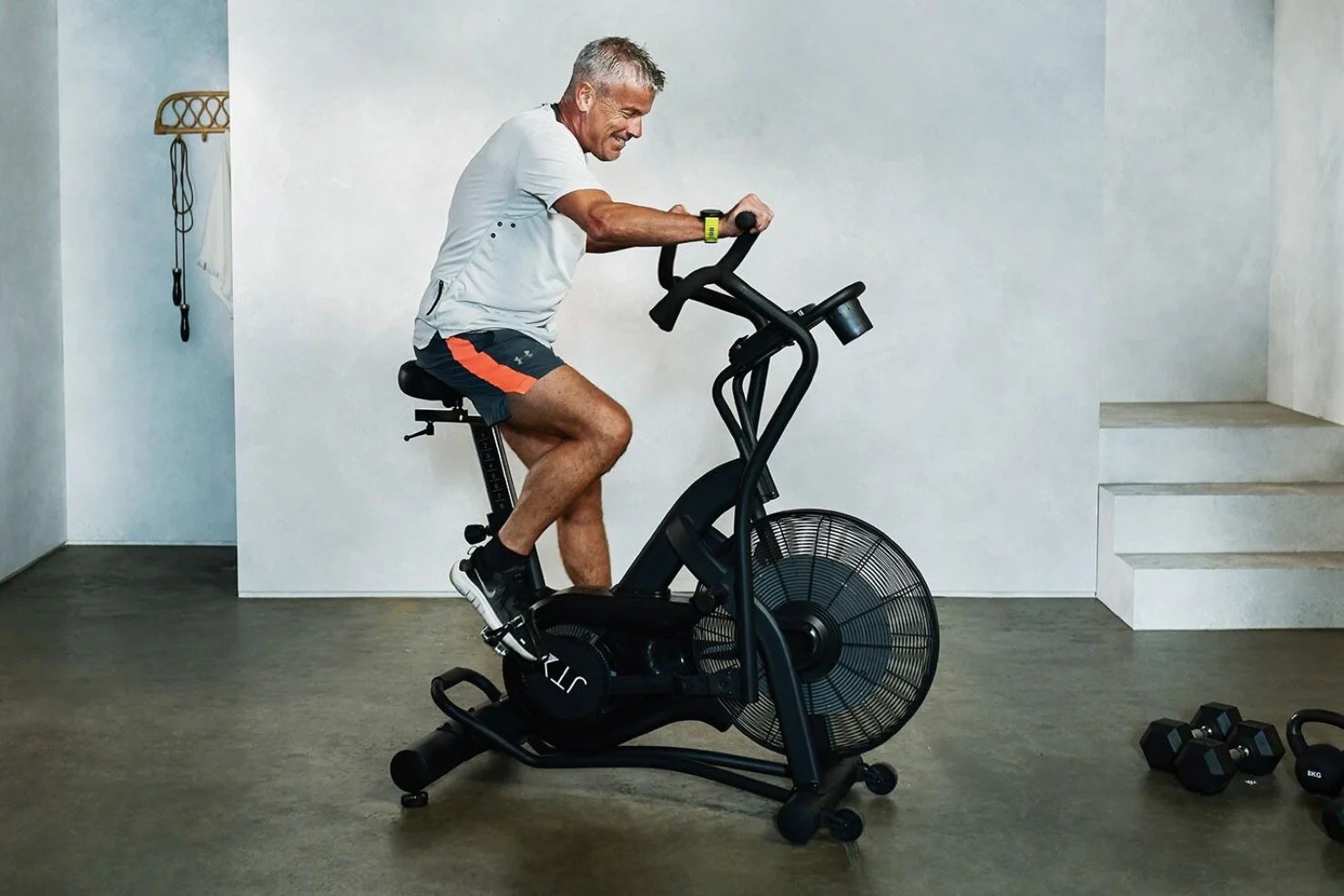
Note: If you’re new to airbikes, be prepared — they deliver a very demanding workout. The harder you push, the more resistance you create, so the effort ramps up fast and feels very different from riding an indoor turbo trainer.
The Airbike by Sportplus used at ChiliTri - low cost but effective
Get your FREE 31 Structured Cycling Sessions and Training Plan
Conclusion: Final Takeaway
You don’t need to train like a professional to benefit from smart, evidence-based tools.
For recreational and age-group athletes:
- VO₂max matters more than you might think
- HIIT or SIT is a proven, time-efficient way to improve it
- Airbikes or Assault bikes are a practical, research-supported way to deliver that stimulus at home
If your goal is maximum aerobic benefit with minimal time, adding an airbike to your training setup is a sensible and effective choice.
Karen Parnell is a Level 3 British Triathlon and IRONMAN Certified Coach, 8020 Endurance Certified Coach, WOWSA Level 3 open water swimming coach, and NASM Personal Trainer and Sports Technology Writer.
Karen has a postgraduate MSc in Sports Performance Coaching from the University of Stirling.
Need a training plan? I have plans on TrainingPeaks and FinalSurge:
I also coach a very small number of athletes one-to-one for all triathlon and multi-sport distances, open water swimming events, and running races. Email me for details and availability. Karen.parnell@chilitri.com
Get your FREE 23-Page Athletes Guide to Strength and Conditioning
Get your FREE Swim Workouts for Triathletes E-book
Get your FREE Open Water Swimming Sessions E-Book
Get your FREE Guide to Running Speed and Technique
Frequently Asked Questions: VO2 max and airbikes/assault bikes
Do I need to be fit to use an airbike for VO₂max training?
No — but you should start conservatively. Airbikes scale automatically to your effort, which makes them suitable for a wide range of fitness levels. Begin with shorter intervals and fewer repetitions and build gradually as your tolerance improves.
How often should I do airbike VO₂max sessions?
For most age group and recreational athletes, one session per week is enough to improve VO₂max. Two sessions can work if recovery is good, but more than that usually adds fatigue without extra benefit.
Will airbike training replace running or cycling?
No. Airbikes are best used as a supplement, not a replacement. They’re ideal for targeted VO₂max work, time-efficient sessions, or periods when impact needs to be reduced.
Are airbikes safe for older athletes?
Yes, when used sensibly. Because they are low-impact and self-paced, airbikes are often well tolerated by older athletes. As with any high-intensity training, a gradual build-up and adequate recovery are key.
Why does airbike training feel so hard?
Airbikes engage both the upper and lower body, which drives oxygen demand and heart rate up very quickly. The fan resistance also increases instantly with effort — the harder you push, the harder it pushes back.
Can I use an airbike if I already train a lot?
Absolutely. Many well-trained athletes use airbikes for VO₂max intervals because they provide a strong cardiovascular stimulus without additional impact, helping manage overall training load.
References
Bacon, A. P., Carter, R. E., Ogle, E. A., & Joyner, M. J. (2013). VO₂max trainability and high-intensity interval training in humans: A meta-analysis. PLOS ONE, 8(9), e73182. https://doi.org/10.1371/journal.pone.0073182
Canário-Lemos, R., Reis, V.M., Garrido, N.D., Rafael-Moreira, T., Peixoto, R., Nobre-Pinheiro, B., & Vilaça-Alves, J. Reliability of maximum oxygen uptake on an Air Bike arm-and leg-ergometer.
Helgerud, J., Høydal, K., Wang, E., Karlsen, T., Berg, P., Bjerkaas, M., … Hoff, J. (2007). Aerobic high-intensity intervals improve VO₂max more than moderate training. Medicine & Science in Sports & Exercise, 39(4), 665–671. https://doi.org/10.1249/mss.0b013e3180304570
Milanović, Z., Sporiš, G., & Weston, M. (2015). Effectiveness of high-intensity interval training (HIT) and continuous endurance training for VO₂max improvements: A systematic review and meta-analysis. Sports Medicine, 45(10), 1469–1481. https://doi.org/10.1007/s40279-015-0365-0
Wen, D., Utesch, T., Wu, J., Robertson, S., Liu, J., Hu, G., & Chen, H. (2019). Effects of different protocols of high-intensity interval training for VO₂max improvements in adults: A meta-analysis of randomised controlled trials. Journal of Science and Medicine in Sport, 22(8), 941–947. https://doi.org/10.1016/j.jsams.2019.01.013
Pearson RC, Garcia SA, Jenkins NT. Comparison of a Ramp Cycle Ergometer and a Staged Assault Fitness AssaultBike Protocol for the Assessment of VO2max. Int J Exerc Sci. 2023 May 1;16(4):613-619. doi: 10.70252/RDUK7353. PMID: 37621380; PMCID: PMC10446946.
Lipscomb T, VAN DER Weyden MS, Boolani A, Andrews BS, Martin J. Agreement of Air Bike and Treadmill Protocols to Assess Maximal Oxygen Uptake: An Exploratory Study. Int J Exerc Sci. 2024 May 1;17(4):633-647. doi: 10.70252/STRQ5031. PMID: 38863601; PMCID: PMC11166135.
This website uses affiliate links which may earn a commission at no additional cost to you. As an Amazon Associate I earn from qualifying purchases. which may cover part of a cup of coffee for me to fuel my training.